What do solar panels and a battery save in the first year? A UK guide to reading your numbers
Last updated: Written by the Geko Energy design teamReviewed by a Geko engineer 8 min
What will solar panels and a battery save in year one? It depends on three things: how much solar you use yourself, how much cheaper electricity your battery lets you buy, and what you earn from exporting the rest. Most of the value comes from not buying electricity at full price, with export payments on top. Expect most of your generation between spring and late summer and very little in winter. That pattern is normal, not a fault.
The first year is when most people check whether their system is doing what they were told. This guide explains where the money comes from, why your bill and your "savings" can look different, and how to judge year one fairly.
Quick answer: the three sources of value in year one
| Source of value | How it works | What decides how much you get |
|---|---|---|
| Solar you use as it's generated | Every kWh your home uses straight from the panels is a kWh you don't buy | How much you use in daylight hours |
| Battery shifting | The battery stores spare solar, or cheap off-peak electricity, for use when grid prices are higher | Battery size, your evening usage and your tariff |
| Export payments | Solar you can't use or store is sold to the grid under the Smart Export Guarantee (SEG) | Your export tariff rate and how much you export |
Swipe to see the full table
Your solar goes three ways
- 1Use it now
Solar your home uses as it's generated. Each kWh is one you don't buy.
- 2Store it for later
The battery keeps spare solar, or cheap off-peak power, for the expensive hours.
- 3Export it
What you can't use or store is paid for under the Smart Export Guarantee.
The Energy Saving Trust puts it simply: you'll typically get around 12p for every unit you export through the SEG, but you'd normally pay more than twice that to buy a unit. That's why using your own solar is usually worth more than selling it, and why a battery can help.
An average install is £12,500. Here's how long that takes to pay for itself at different yearly savings:
| Value in a year | Years to pay back |
|---|---|
| £1,000 | About 12.5 years |
| £1,250 | About 10 years |
| £1,500 | About 8.3 years |
| £1,750 | About 7.1 years |
| £2,000 | About 6.3 years |
Swipe to see the full table
Your own figure depends on your roof, usage and tariff. For our view of the overall maths, read is solar still worth it in 2026?
Want an estimate for your roof?
Why your solar arrives unevenly through the year
UK solar is strongly seasonal. Long summer days produce many times more than short winter ones, so your monthly app totals will rise and fall sharply.
To show the pattern, we modelled a 4kWp system near Birmingham, tilted at 35°, in the European Commission's PVGIS tool (2005–2023 weather data). It's an illustration, not a forecast for your home:
| Season | South-facing share of the year | West-facing share of the year |
|---|---|---|
| Winter (Dec–Feb) | About 13% | About 8% |
| Spring (Mar–May) | About 32% | About 34% |
| Summer (Jun–Aug) | About 35% | About 41% |
| Autumn (Sep–Nov) | About 20% | About 17% |
Swipe to see the full table
Two things stand out:
- Winter is quiet, especially on east or west roofs. In this model, December produced just over a quarter of what July did on the south-facing roof, and about an eighth on the west-facing one.
- East and west roofs lean even harder on summer. They still work well. The Energy Saving Trust says they tend to get around 15–20% less energy than a south-facing roof. (In this particular PVGIS model the gap was a little wider, at about 3,020 kWh a year against 3,870 kWh.) More on orientation in does your roof need to face south?
So don't judge your system by November. Judge it on the full year, and compare like-for-like months in later years.
How a battery adds to the savings
A battery doesn't make more electricity. It changes when you use it. According to the Energy Saving Trust, it can:
- store spare solar in the day that you'd otherwise export for less
- use that stored energy to avoid more expensive tariff periods
- charge from the grid when your tariff is cheap, which matters most in winter when there's little solar to store
- on some more innovative tariffs, sell electricity from the battery at peak times
That last-but-one point is why year-one savings on a battery system are usually spread across the seasons. In summer the battery mostly stores solar. In winter, on a time-of-use tariff, it mostly stores cheap overnight electricity.
A few caveats from the Energy Saving Trust:
- Some energy is lost. Using stored energy is less efficient than using it directly, so a little of what goes in doesn't come back out.
- Batteries keep a reserve. Systems usually stop discharging at a set level, maybe 20% of capacity, to protect battery life.
- Batteries don't last as long as panels. The typical lifespan is about 10 to 12 years.
Is a battery right for you in the first place? Read battery or no battery? When it pays off, then our home battery quote checklist.
Savings mode or independence mode?
Most home batteries can be set up in different ways, and the choice changes your year-one results:
| Setting | What the battery does | Best for |
|---|---|---|
| Self-use / self-consumption | Fills from spare solar and powers the house whenever it can | Homes on a flat-rate tariff, or anyone who wants to buy as little from the grid as possible |
| Time-of-use / tariff-led | Charges when electricity is cheap and covers the expensive hours, using the tariff's price gaps | Homes on a time-of-use tariff, especially with an EV |
Swipe to see the full table
Here's the bit that surprises people. On a tariff-led setting, your home can still buy a fair share of its electricity from the grid, because some of it is cheap overnight power the battery has stored. Your "self-sufficiency" figure may look modest even though your bill is lower. Self-sufficiency and savings are different goals. Pick the one that matters to you, and check your app is set up for it.
Tariffs change often. For current rates and times, read our comparison of Intelligent Octopus Go, Flux and E.ON Next Drive, and if you drive electric, charging an EV with solar.
Power cuts: standard grid-tied solar switches off during a power cut for engineers' safety. Backup isn't automatic. It needs a battery set up with a dedicated backup circuit or backup equipment, so ask for it at quote stage if it matters to you.
A worked example: adding up a year
Your monitoring app will show how much solar you generated, used, stored and exported, and how much you imported. Here's how to turn that into a value. The figures below are example numbers to show the method, not a forecast or a typical result. They are for a system around an average install price of £12,500: about 6kWp of panels making 5,400 kWh a year, with a 10kWh battery.
Example rates: full-price import 28p/kWh, off-peak import 8p/kWh, export 12p/kWh.
| Part of the year's energy | Example kWh | Sum | Example value |
|---|---|---|---|
| Solar used as it was generated | 1,600 | 1,600 × 28p | £448 |
| Solar stored and used later | 1,800 | 1,800 × 28p | £504 |
| Off-peak grid power used instead of full-price power | 1,200 | 1,200 × (28p − 8p) | £240 |
| Solar exported under the SEG | 2,000 | 2,000 × 12p | £240 |
| Total value in the year | £1,432 |
Swipe to see the full table
Notice the split. The first three rows show up as a lower bill. The export row usually arrives as a separate credit from your SEG supplier. If you only look at your bill, you'll miss part of the value. If you only look at the total, you may expect a bigger drop in your bill than you'll see.
On a £12,500 install, £1,432 a year is a simple payback of about 8.7 years (£12,500 ÷ £1,432). For a tighter figure, swap in your own tariff's rates and allow for some battery losses.
How to check your own first-year numbers
- 1Find your MCS estimate. Every MCS-certified installer must give you an annual generation estimate. Under MCS's solar standard, MIS 3002, it must say performance is "impossible to predict with certainty" and that the estimate is "guidance only for the first year of generation". So treat it as a guide, not a promise.
- 2Compare generation against it. Being a little above or below in one year is normal. Weather varies.
- 3Total up the value, using the method above with your real rates.
- 4Check your export is being paid. SEG payments are calculated from export meter readings. If you have no export credits, contact your SEG supplier. Ofgem says SEG rates must always be above zero, and suppliers set their own terms, so it pays to shop around. See the Smart Export Guarantee, explained.
- 5Check the battery's settings match your tariff, especially if you've switched supplier since installation.
- 6Look for sudden drops in generation in good weather. That can point to an inverter fault or new shading. If output stays low in good weather, ask your installer to check the system.
Numbers don't add up?
Small habits that add up
You don't need to change your life to get value from solar, but a few habits help:
- Summer: run big appliances in daylight. Set the washing machine, dishwasher or tumble dryer to run when the panels are producing. The Energy Saving Trust suggests using timers if you're out during the day.
- Winter: use the cheap window instead. When there's little solar, shift the same appliances into your tariff's off-peak hours if you have one.
- Charge an EV from the sun when you can. The Energy Saving Trust notes you can charge an EV during the day while the panels are generating.
- Keep an eye on the app once a month. It's the quickest way to spot a fault or a setting that needs changing.
How Geko designs for year-one savings
Year-one results start with design. On a free 30-minute video consultation, a Geko engineer looks at your roof, shading and usage and models what you'll use, store and export, not just how much you'll generate. There are no doorstep sales and nobody on commission.
- Panels: Aiko and DMEGC Tier-1 panels.
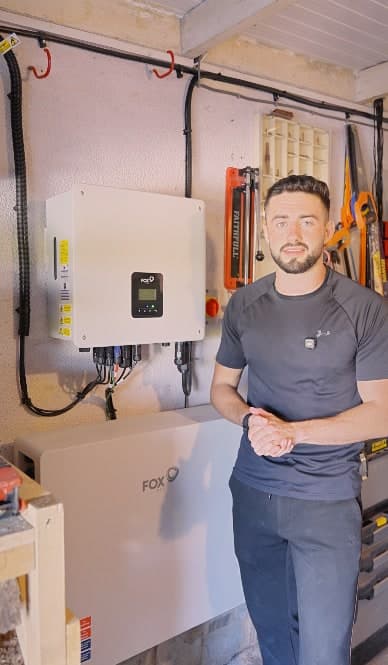
- Batteries: Tesla Powerwall 3, Fox ESS, Sigenergy and EcoFlow PowerOcean systems sized to your home, with app monitoring so you can see every kWh generated, used, stored and exported. Optional backup for power cuts.
- Installation: our own employed engineers install across England and Wales.
- Protection: we're MCS-certified for solar PV and battery storage and TrustMark-registered, and every install has a 6-year IAA insurance-backed guarantee.
- Paperwork: we handle the DNO notification, your MCS certificate and SEG registration.

Call 07700 140545 (Mon–Fri, 9am–6pm), book a video consultation or get a quote.
FAQs
How much do solar panels and a battery save in the first year?
It depends on your roof, usage, battery size and tariffs, so there's no single figure. Add up the solar you used, the cheaper electricity your battery let you buy and your export income. Divide an average install of £12,500 by that yearly total for a simple payback: £1,250 a year pays it back in about 10 years.
Why did my solar generate so little in winter?
That's normal. UK days are short and the sun is low. In our PVGIS illustration for a south-facing roof near Birmingham, December to February produced only about 13% of the year's output.
Why is my self-sufficiency lower than I expected?
If your battery is set to follow a time-of-use tariff, it will charge from cheap grid power, so you still import some electricity. That can lower your bill more than chasing independence does.
Is it better to use my solar or export it?
Usually use it. The Energy Saving Trust says you'll typically get around 12p per exported unit but normally pay more than twice that to buy one.
Does my battery work in a power cut?
Only if it was set up for backup. Standard grid-tied systems switch off in a power cut for safety. Backup needs a dedicated backup circuit or backup equipment, so check your paperwork or ask your installer.
My first-year generation was below the MCS estimate. Is something wrong?
Not necessarily. MCS says the estimate is guidance only for the first year and that sunlight varies from year to year. Look at the trend over several years, and investigate sudden drops in good weather.
Does a battery lose energy?
A little. The Energy Saving Trust notes that using stored energy is less efficient than using it directly, and most systems keep a reserve, maybe 20%, so the battery never empties fully.
How do I make sure I'm being paid for export?
Register with an SEG tariff and check your export credits. Payments are calculated from export meter readings, and you can choose your SEG supplier. Ofgem advises shopping around.
See what your roof could save
A free 30-minute video consultation with one of our engineers, then one total price for a system designed around what you'll use, store and export.
Phone lines open Mon–Fri, 9am–6pm
Sources
- Energy Saving Trust: Solar panels
- Energy Saving Trust: Battery storage
- Ofgem: Smart Export Guarantee (SEG)
- MCS: MIS 3002 The Solar PV Standard, issue 6.0
- European Commission Joint Research Centre: PVGIS (4kWp, 35° tilt, 14% system loss, near Birmingham, PVGIS-SARAH3 2005–2023)
- Geko Energy: battery storage, Fox ESS, Sigenergy, MCS certification
Geko Energy designs and installs solar PV, battery storage and EV charging. Savings depend on your home, usage and tariffs. Seasonal shares are a PVGIS illustration and the worked example uses example numbers to show the method; neither is a forecast for any specific system. Payback figures use an average install of £12,500; your quote depends on your home. Tariff rates change, so check your supplier's current prices.